Why Does One Batch Scoop While Another Turns Icy?
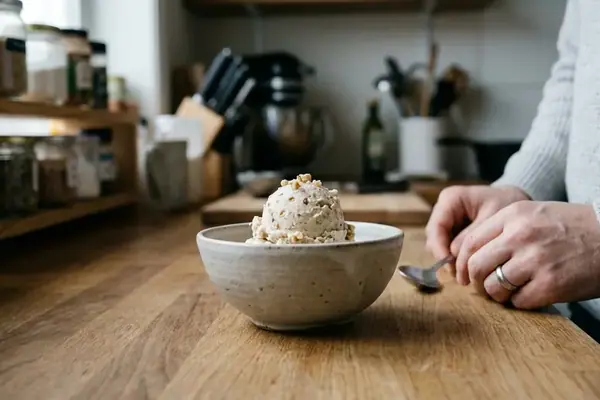
In a Melbourne home kitchen, the first spoonful often tells the whole story. A batch pulled from a freezer sitting near -18°C to -20°C resists for a few seconds. The surface then softens under the spoon and rolls into a creamy curl. Last week’s batch, made in the same machine, may have splintered instead, exposing ice that looked coarse even before it reached the tongue.
That contrast leads to a practical question: should homemade ice cream rely on egg yolks, cornstarch, or natural gums?

Each takes a different route. Yolks emulsify fat and water while building custard body. Cornstarch thickens the liquid and reduces water movement. Gums manage water efficiently with comparatively little effect on flavour, provided they are measured and hydrated correctly.
The spoon alone cannot name a universal winner. It can reveal whether the formula, preparation and storage worked together. Coarse crystals become perceptible at roughly 40–50 microns, so visible grit usually signals more than a batch that simply froze hard.
Mind The Shelf
Compare batches after equal hardening time and on the same freezer shelf. Ice cream stored in the door will read softer because it experiences warmer, less stable conditions.
What Is Scoopability Actually Measuring?
Scoopability describes how readily frozen ice cream yields to a spoon. Creaminess asks a wider set of questions: how large are the crystals, how is the fat structured, how much air was churned in, and what happens as the scoop melts?
Water keeps moving after the lid goes on. During a warm spell, some ice melts; when the temperature falls again, that water tends to join existing crystals. A freezer cycling by 3–4°C during defrost or frequent door-opening can accelerate this recrystallisation. Repeated cycles over two to three weeks often turn a previously smooth batch coarse.
The Formula Works As A System
- Sugar depresses the freezing point, leaving part of the water unfrozen at serving temperature.
- Fat contributes richness and helps shape the structure formed during churning.
- Milk solids add body and bind some of the available water.
- Air changes density, resistance and the way a scoop collapses on the tongue.
- Stabilisers slow water movement and influence viscosity, hardening and melt.
A stabiliser operates inside that system. Adding more cannot automatically correct excess free water, low sugar, weak churning or unstable storage. This distinction matters because an ice cream can feel soft while still tasting icy, or feel dense and creamy while requiring a short rest before scooping.
Egg Yolks: Richness, Emulsification, and Custard Body
Yolks make sense when the desired ice cream should taste like custard. Their proteins thicken under heat, while their emulsifiers help distribute fat through the water-based portion of the mix. The finished scoop tends to feel rounded, rich and deliberate, with a slower melt and the familiar colour of a cooked custard base.
Temperature control decides whether that richness stays silky. Custard reaches a coat-the-spoon, or nappe, consistency between 76°C and 82°C. Beyond about 85°C, yolk proteins begin forming visible curds.
A Careful Custard Workflow
- Whisk the yolks with part of the sugar until evenly dispersed.
- Warm the dairy separately, avoiding a hard boil.
- Pour a little warm dairy into the yolks while whisking, then repeat. This tempering step raises their temperature gradually.
- Return the mixture to the pan and cook over low-to-medium heat, stirring constantly.
- Judge doneness by nappe. Cooking commonly takes roughly 6–10 minutes after the dairy has warmed, though the pan and heat source affect the pace.
- Strain if small curds appear, then chill thoroughly before churning.
Yolks also bring a clear sensory signature. That character flatters vanilla, coffee and toasted flavours; it can muffle a delicate floral note or a particularly bright fruit. Their value therefore lies in both structure and flavour, which should be considered together.
Cornstarch: An Egg-Free Route to a Fuller Base
Cornstarch offers a direct, accessible way to make an egg-free dairy base feel more substantial. When heated in liquid, its granules swell and thicken the mixture, limiting the mobility of water. It does not supply the emulsifying action or custard flavour of yolks, so the result usually tastes cleaner and more dairy-forward.
Dispersion is the crucial step. Stir cornstarch into cold liquid until the slurry is completely smooth, then whisk it into the base. Bring the mixture to a genuine simmer and hold it there for one to two minutes. A brief warm-through leaves a raw, chalky impression because the starch has not fully gelatinised.
Slurry First
Never scatter dry cornstarch into a hot base. The outside of each clump swells immediately and traps dry starch inside, leaving lumps that vigorous whisking may only break into smaller lumps.
Quantity becomes especially important when the fat level changes. The same cornstarch amount that gives a full-fat dairy base pleasant body can dominate a lightened base, making it read as pasty or pudding-like. Much beyond 1–1.5 tablespoons per litre pushes texture in that direction.
Cornstarch suits flavours where eggs would feel intrusive but a little density is welcome. It remains a thickener rather than a complete substitute for everything yolk contributes, so sugar, milk solids, fat and storage still carry their share of the work.
Natural Gums: Powerful Water Control in Small Amounts
“Natural gums” is a convenient kitchen label for ingredients that behave quite differently. Guar, locust bean gum and xanthan cannot be swapped casually at the same measure and under the same heating conditions.
They share a broad purpose: increasing viscosity and restricting water movement during freezing and storage. Their strength lies in efficiency and flavour neutrality. That same efficiency makes them unforgiving.

Hydration Changes By Gum
- Guar gum hydrates in cold liquid.
- Locust bean gum needs heating near 80–85°C to reach full viscosity.
- Xanthan gum hydrates quickly at room temperature.
Under typical conditions, some combinations behave differently from a single gum used alone, so a blend should be treated as its own ingredient. Whatever the choice, dispersing the gum through sugar or another dry carrier before adding liquid helps prevent small gelled clumps.
Weigh The Gum
Gums work in the fraction-of-a-percent range by base weight. A variance not far from 0.1 g can alter the result, and volume descriptions such as “a scant teaspoon” are unreliable. This method assumes a scale capable of reading 0.1 g.
Storage exposes excess more clearly than the first tasting. I have seen a gum-stabilised base taste clean and scoop neatly on day one, then become slick and unusually slow-melting after two weeks because the dose sat at the top of its range. More control can quietly become too much control.
How Do Yolks, Cornstarch, and Gums Compare?
The useful comparison extends beyond the chilled base. Refrigerator viscosity, frozen texture and melt quality describe separate stages, and each can point in a different direction. A glossy base at 4°C can still harden icy when its unfrozen water remains poorly controlled.
Comparison of stabilising systems for homemade ice cream| Criterion | Egg yolks | Cornstarch | Natural gums |
|---|---|---|---|
| Primary function | Emulsification and protein thickening | Starch thickening and reduced water mobility | Viscosity and precise water management |
| Flavour impact | Rich, distinctly custard-like | Clean and relatively neutral | Minimal when correctly dosed |
| Body | Rounded and rich | Full and substantial | Can range from light to elastic |
| Melting behaviour | Usually slower and creamy | Thick, with a risk of pastiness | Controlled, with a risk of slickness |
| Preparation demands | Tempering and careful heating | Cold slurry and full simmer | Accurate weighing and gum-specific hydration |
| Dietary fit | Contains egg | Useful for egg-free dairy bases | Useful where egg-free and neutral flavour matter |
| Common failure | Curdling from excessive heat | Lumps or pudding-like texture | Slick, gummy or elastic texture |
Choose yolks for custard richness and emulsification, cornstarch for approachable egg-free thickening, and gums for precise water control. The thickest liquid in the refrigerator does not automatically produce the best frozen scoop. Hardening, crystal perception and melt deserve their own judgment.
How to Test the Stabilisers Without Fooling Your Palate
A fair kitchen test starts with restraint. Pick one familiar base and hold the dairy, sugar, flavouring, batch size, chilling period, machine, container shape and freezer position constant. Change only the stabilising system. An unstabilised control makes each contribution easier to recognise.
Preparation should still respect the ingredient. Yolks need tempering, cornstarch needs a simmer, and each gum needs its proper hydration conditions. Forcing all three bases through an identical heating routine creates tidy paperwork and misleading ice cream.
A Matched-Batch Protocol
- Prepare each base with the same ingredient proportions apart from the stabilising system.
- Chill every base for the same period: at least four hours and ideally overnight, allowing fat and hydration to equalise.
- Churn in the same machine under comparable conditions.
- Pack into containers of the same shape and depth, then harden on the same freezer shelf.
- Taste each sample after eight to ten minutes at counter temperature. This prevents a merely hard batch from masquerading as a better formula.
- Reassess after one to two weeks, looking for coarseness, gumminess, pastiness and changes in melt.
Write separate notes for spoon resistance, crystal texture, flavour release and the puddle left behind. A single score compresses useful differences. The first scoop measures hardening; the later tasting begins to reveal storage stability.
Choose the Stabiliser That Fits the Ice Cream
For a rich vanilla custard, yolks earn their place because their flavour belongs in the finished scoop. Cornstarch suits an egg-free dairy ice cream where clean flavour and fuller body matter. A carefully weighed gum makes sense when a bright fruit, floral infusion or other delicate flavour should remain clear.
Before increasing any stabiliser, inspect the whole formula. Macerated fruit can release enough free water to undo the stabilising system; concentrating or straining it tackles the source. Also check sugar balance, chilling time, the machine’s churning capacity, container depth and freezer temperature swings.
Deep, narrow containers harden more evenly than wide, shallow ones because they expose less surface to changing temperatures. That storage choice may do more for the second week than another pinch of thickener.
The decisive next move is simple: prepare one known base consistently and compare one stabilising system at a time. Keep the recipe and method steady long enough to see what the ingredient actually contributes. With gums in particular, the margin between restraint and a slick, slow-melting scoop can be shy of 0.1 g.