Bragioli begin with a practical bit of kitchen thinking: take modest braising beef, pound it thin, tuck in a savoury filling and let time turn the rolls tender. This version follows Nanette’s family table, where bacon, hard-boiled egg, tomato and peas make a generous Sunday dish for six.
Quick Nav
- Bragioli at the Maltese family table
- Beef, stuffing and pan selection
- Pounding the beef evenly
- Filling and securing the rolls
- Browning and building the sauce
- Testing the braise for tenderness
- Slicing and serving
Bragioli at the Maltese Family Table
On a Maltese table, bragioli show how thrift and care can meet in the same casserole. Thin slices from economical braising cuts gain substance from a little bacon and egg. Pounding makes the beef broad enough to fill, while slow cooking gives a tougher cut the time it needs.
English descriptions often call them “beef olives,” although olives do not define the dish. The name describes the rolled shape more readily than the ingredients tucked inside.
Family versions travel in several directions. Some cooks use minced fillings; others change the sauce or reach for a different cut of beef. Nanette’s Maltese-rooted version uses chopped streaky bacon, hard-boiled egg and parsley inside, then braises the rolls in tomato with peas added near the end. It represents one household’s method rather than a declaration of a single canonical recipe.
That distinction matters in heritage cooking. A recipe survives because people keep cooking it with the ingredients, pans and appetites in front of them. Here, the method was settled around a standing Sunday table of six, with enough filling for every roll to receive an equal share.
Choose the Beef, Stuffing and Braising Pan
Ask the butcher for six broad slices cut across topside or blade, each weighing about 120–140 g. Wide slices are easier to turn into compact parcels than long, narrow steaks. They should tolerate pounding to roughly 16 × 12 cm without the grain breaking apart.
For Six Beef Rolls
- 6 slices topside or blade beef, 120–140 g each
- Salt and black pepper for the inner surfaces
For the Bacon-and-Egg Filling
- About 150 g streaky bacon rashers, finely chopped
- 3 eggs
- 2 tablespoons chopped flat-leaf parsley
Lower the eggs into simmering water and boil them for 9 minutes. Cool, peel and chop them before combining them with the bacon and parsley. Chopping rather than mashing keeps small pieces of white and yolk visible when the finished roll is cut.
For the Tomato and Pea Sauce
- 1 large onion, chopped
- 2 garlic cloves, chopped
- 400 g tinned chopped tomatoes
- 2 tablespoons tomato paste
- 250 ml beef stock
- 1 bay leaf
- 150 g frozen or fresh podded peas
A heavy casserole with a close-fitting lid, 26–28 cm across, holds all six rolls in one snug layer. A 20 cm pan forces them to stack, leaving the upper rolls away from the steady heat and sauce.
Give Them Room
Choose the casserole by its base, not its stated capacity. Six bragioli need enough floor space to lie side by side during the braise.
Pound and Portion the Beef Without Tearing It
Place one beef slice between two sheets of baking paper. Baking paper stays smooth under the mallet; plastic wrap can bunch into creases and mark the meat.
- Set the flat face of the meat mallet over the centre of the slice.
- Strike with steady, moderate force, working outwards in overlapping rows.
- Keep the mallet level. An angled edge cuts into the grain.
- Lift the baking paper occasionally and check for thick ridges.
A slice usually needs about 30–45 seconds of measured pounding. Heavy blows may look efficient, but they tear the grain before the meat has a chance to spread.
Aim for a thickness of about 4–5 mm. The more useful test happens when the slice is lifted: it should drape easily, remain broad enough to roll and show no stiff ridge down the middle. Below 4 mm, twine can cut through at the tie point and the beef may become tender much earlier than the braising range used here.
Irregular slices need a little arranging rather than aggressive trimming. Turn a thin flap inward or position it along a side that will be folded. Any small trim can sit beneath the filling, provided it does not create a bulky patch.
Keep Raw Tools Apart
Use a clean spoon to portion the stuffing and keep it away from the raw beef. Wash the board, mallet and bench in hot soapy water before cooked bragioli return to the work area.
Fill, Roll and Secure Each Bragiola
The seam holds when the filling stays modest and the side folds happen first. Lay a pounded slice with a short edge nearest the cook, then season the upward-facing surface lightly.
- Place a narrow line of bacon-and-egg filling near the short edge closest to the body.
- Leave about 1.5 cm clear along both sides and 2 cm at the far edge.
- Fold the two sides inward over the ends of the filling.
- Roll the beef away from the body, keeping the parcel firm without squeezing it.
- Finish with the seam underneath.
The clean border gives the final flap somewhere to adhere. Filling spread right to the far edge presses into the seam during browning. That is how chopped egg can land in the tomato before the braise has even begun.
Kitchen twine gives even support to an irregular roll. Tie each bragiola twice, placing the loops roughly one-third and two-thirds along its length. Toothpicks work faster and suit tidy rolls, though the cook must count them going in and count them again when they come out.
Set the assembled rolls seam-side down on a plate, cover and refrigerate for 15–20 minutes. The brief rest firms the shape and helps the seam stay closed when it meets the hot casserole.
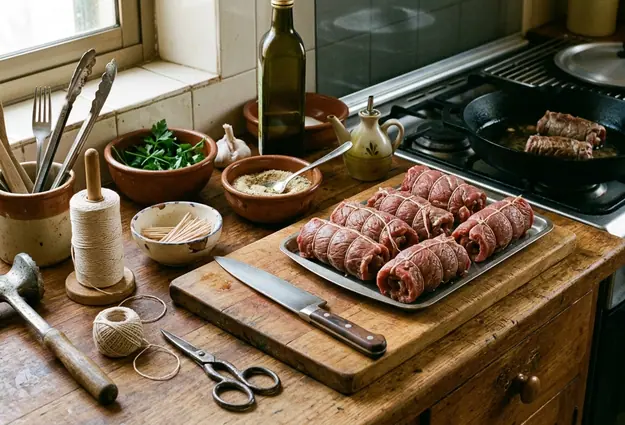
Brown the Bragioli and Build the Tomato Sauce
Pat the outside of every chilled roll dry with paper towel. Heat the casserole over medium-high heat, then add three rolls seam-side down. Leave finger-width gaps between them.
Brown each face for 2–3 minutes, turning carefully with tongs until the rolls have coloured all around. One batch takes about 8–10 minutes. Grip across the body of the roll rather than catching the twine or lifting by a toothpick.
Browning all six together drops the pan temperature. Beef juices pool, the surface turns grey and the softened seam begins to slacken. Working in two batches keeps the heat steady. The aim is colour on the exterior; the centres will cook during the braise.
Once the rolls are out, lower the heat to medium. Soften the onion for 6–8 minutes, then add the garlic. Stir in the tomato paste and cook it for another 1–2 minutes, until it deepens to a brick colour. Add the chopped tomatoes, stock and bay leaf, scraping the browned residue from the casserole base into the sauce.
Stop Blackening Early
If the residue shifts from deep brown to black, pull the casserole off the heat and add the stock immediately. Burnt deposits carry bitterness through the sauce and cannot be repaired later.
Braise Until the Beef Yields to a Knife
Return the bragioli to the casserole in a single snug layer. The sauce should reach roughly two-thirds of the way up their sides. Cover the pan and bring it to a quiet simmer, meaning a bubble breaks the surface about every one to two seconds.
Braise for 75–90 minutes. Turn each roll once at around the 45-minute mark, then leave it alone. Repeated movement can loosen the fastenings and open a seam.
The clock gives a useful window; the skewer gives the answer. Push a thin knife or metal skewer into the thickest part of a roll. Tender beef offers almost no drag as the point enters and withdraws. A roll that remains firm after 75 minutes generally needs another 15 minutes under the lid with the simmer kept gentle.
Rapid boiling tightens the meat and reduces the tomato sauce before the beef softens. If the sauce grows too thick, move the casserole off the boil and add hot stock 2 tablespoons at a time. If the rolls become tender while the sauce remains loose, transfer them to a warm plate and reduce the sauce uncovered over medium heat for 8–12 minutes.
Add the peas for the final 10–12 minutes. Frozen peas go straight in from frozen. Fresh podded peas need the same time or slightly less; a full braise would dull their colour.
Trust the Skewer
The 75–90 minute range assumes topside or blade pounded to 4–5 mm. Thinner slices or leaner round may pass the tenderness test near 60 minutes and can dry out if held for the full period.
Slice the Bragioli and Spoon Over the Pea Sauce
Lift the tender rolls onto a board and rest them for 8–10 minutes. Remove every piece of twine or every toothpick before the knife comes out. A written count helps when toothpicks have disappeared beneath the sauce.
Bragioli may go to the table whole, especially for an informal supper. For a shared Sunday plate, cut across the grain into rounds about 2 cm thick. The short rest helps the bacon-and-egg spiral remain in place rather than sliding onto the board.
Arrange the rounds with their cut faces visible and spoon the tomato and pea sauce around them. Leaving the spiral uncovered shows the work inside each roll. Boiled or roast potatoes, mashed potato and torn crusty bread all catch the sauce well; each is an option rather than a prescribed pairing.
Cool leftovers and refrigerate them within 2 hours, keeping the rolls submerged in sauce. They hold for 3 days at or below 5°C. Reheat covered over low heat for 15–20 minutes, until the centre reaches 75°C, loosening a firm sauce with a splash of hot stock.
At the Sunday table, Nanette sets down the platter with the first bragiola already sliced. Yellow egg, parsley and bacon curl through the centre. Someone nudges a piece of bread into the pea sauce while the casserole is still warm.