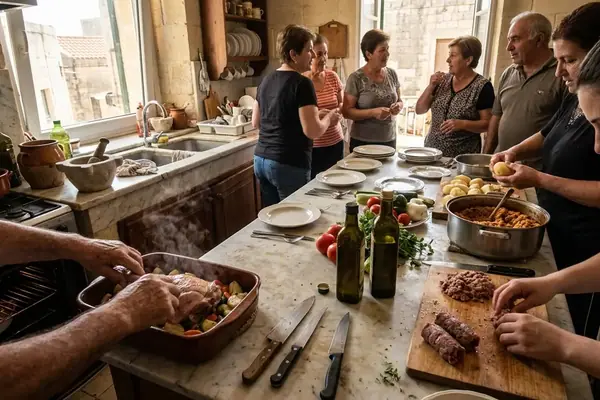
A Mediterranean recipe can become more faithful through thoughtful adaptation. That sounds contrary until the recipe leaves the page and meets an actual kitchen: tomatoes in July, an absent cheese, an extra chair at the table, or a pan inherited from somebody who cooked by scent and sound.
Why Adaptation Belongs at the Mediterranean Table
The clearest argument sits in three surviving handwritten versions of the same family dish. Across a mother’s and grandmother’s kitchens, the protein changes, the tomato appears in different forms, and the yield expands or contracts. The cards document continuity without uniformity. Each cook kept the dish moving through her own pantry and household.
Published recipes often encourage us to treat an ingredient list as the dish’s permanent identity. Family papers tell a more complicated story. They preserve corrections, substitutions and quantities written for a particular gathering. A crossed-out line can reveal as much about tradition as the neat title at the top.

Season makes this especially plain in Melbourne. Victorian-grown field tomatoes have a useful window from roughly late December through March. That is when a fresh-tomato heritage sauce makes sense. Outside that period, tinned tomatoes are the sensible reading of the recipe because they provide the ripeness and concentration the sauce requires.
Authenticity lives in the continuity of flavour, technique, purpose and cultural memory. Exact repetition sometimes supports those things. At other times, it works against them by forcing weak produce or an unsuitable ingredient into a dish simply because the written version named it.
How the One-True-Recipe Test Distorts Home Cooking
A recipe records one cook’s decision at one moment. Once printed, that decision can harden into a rule and flatten all the neighbouring household versions. Regional conventions matter, of course. They help us understand why a dish tastes, looks and functions as it does. They do not mean that every family within the region cooked identically.
Precision With a Purpose
The useful line falls between measurements that control a physical process and measurements that merely describe one acceptable outcome. Side-by-side kitchen testing makes the distinction visible. A slow tomato braise tolerated a swing of about a third in onion volume and another 20 minutes of simmering without diners remarking on a difference. The cook could follow the pan.
Brining behaved very differently. A lemon or olive brine mixed noticeably weaker than the family standard developed cloudiness and softening within 10 to 14 days. A brine mixed by eye later spoiled within a fortnight. In preservation, salt concentration governs safety and texture, so casual adjustment carries consequences.
Pastry exposes the same boundary. Sugar syrup for honey-ring-style Maltese pastry sets reliably at thread stage. Taken from the heat two or three minutes early, it remains tacky at room temperature and never firms. Ratios and endpoints earn their authority here.
Measure the Brine
Use judgement freely in braises, soups, sauces and vegetable dishes where tasting can guide correction. Weigh brines and respect setting stages in preserves and pastry.
Resourcefulness Is Part of the Mediterranean Inheritance
Home cooking responds to what the market has, what the garden produced, what remains from yesterday, what the household can afford and how many people have arrived for dinner. Resourcefulness belongs inside the tradition. It explains why a sauce gets stretched, an abundant vegetable takes centre stage, or a local cheese replaces one that never reached the neighbourhood shop.
I find substitution decisions clearer when every ingredient receives a job description before shopping: salt, fat, acidity, aroma, body, texture or cooking behaviour. Matching that function gives a replacement a chance of belonging. Visual resemblance alone tells us little.
Consider aubergine. A medium fruit salted on a rack for 30 to 45 minutes releases liquid in visible beads, changing how much oil it takes up in the pan. Deep-frying diced aubergine absorbs roughly three to four tablespoons of oil per medium fruit. The same weight roasted needs about one and a half tablespoons brushed over it. Both methods can serve the dish, though they produce distinct textures.
Timing matters too. Local Victorian eggplant peaks from January into April. Cold-stored fruit bought in July tends towards denser seeds, more bitter skin and less sugar available for caramelisation. The cook may need longer browning and a tomato sauce with enough sweetness and concentration to carry the vegetable.
Keep the Job
Before replacing an ingredient, name what it contributes. Choose for function first, then check whether its flavour still belongs beside the other ingredients.
When a Variation Becomes a Different Dish
Adaptation needs fair boundaries. Four anchors offer a practical way to locate them: the defining technique, the dominant ingredient, the characteristic flavour balance and the dish’s cultural role at the table.
- Defining technique: the action that creates the expected form or texture.
- Dominant ingredient: the ingredient diners identify before any garnish or seasoning.
- Flavour balance: the familiar relationship among salt, sweetness, acidity, fat, herbs and spice.
- Cultural role: whether the dish appears as a weekday meal, feast sweet, preserve, side dish or shared centrepiece.
Changing one secondary ingredient may leave all four anchors steady. Replacing the main ingredient, method and flavour profile together usually creates another dish. The new result may be delicious; accurate naming gives both preparations room to stand on their own.
The blog’s naming convention makes that distinction readable. “Family version” marks an inherited household change. “Melbourne pantry version” identifies an adjustment driven by local supply. “Inspired by” applies when either the defining ingredient or defining technique has been replaced.
This four-anchor test belongs to home cooking, where the cook can taste and adjust. Restaurant menus, competitions and protected regional designations may impose external rules that a family kitchen never had to answer.
A Five-Question Test Before You Change the Recipe
Lists of permitted and forbidden substitutions collapse quickly in a real shop. A short sequence of questions travels better because it examines the dish and the reason for changing it.
- What will diners recognise first? Identify whether the principal signal is the main ingredient, cooking method, seasoning, texture or way the dish is served.
- Why is the change needed? Separate seasonality, availability, cost, dietary need and waste reduction from simple personal preference. Each reason allows a different degree of compromise.
- What job does the original ingredient perform? Decide whether it supplies salt, fat, acidity, fragrance, structure, moisture or a particular reaction under heat.
- Which anchors will move? A secondary herb may alter the aroma slightly. A new main ingredient and method can shift the entire identity.
- Where will you taste and correct? Plan checkpoints while adjustment remains possible, rather than judging only at the table.
Change one substantial element per cook-through. Taste after the vegetable browns, after the sauce reduces, and once the pasta or grain joins the pan. This keeps cause and effect legible. If the adjustment works, date it in the recipe margin and record the reason, such as season, supply or preference. The next cook can then distinguish an inherited choice from a one-off experiment.
Put the Test to Work on an Aubergine and Tomato Pasta
A pasta of aubergine, tomato, basil and firm salty cheese offers a useful test because its identity rests on several linked sensations. The aubergine needs browned edges and a yielding centre. The tomato should taste concentrated. The pasta must retain texture, basil supplies herbal freshness, and the cheese finishes the bowl with dry, salty crumbs.
Roasting Instead of Frying
Fried aubergine turns silkier and heavier, with a collapsed centre that carries oil through the sauce. Roasting gives a firmer edge and a lighter finish, useful in a weeknight kitchen. The adjustment preserves the dominant ingredient and browned flavour while changing the texture by a manageable degree.
Cut the aubergine into 3 cm pieces. Brush them with oil rather than tossing them, then roast at 220°C fan for 22 to 28 minutes, turning once halfway through. Look for properly brown cut faces; softness alone leaves the vegetable bland and grey. Winter fruit may need closer attention because the standard 22-minute roast can be insufficient for its denser, more bitter flesh.
Reduce the tomato sauce for 35 to 50 minutes, depending on whether it began with ripe summer tomatoes or tinned ones. Draw a spoon through the pan. The track should close slowly. Salt the pasta water at 8 to 10 g per litre, pull the pasta 60 to 90 seconds before the packet time, and finish it in the sauce.
Choosing the Cheese
Ricotta salata gains its dry crumble from being pressed, salted and aged for roughly two to three months. Any replacement must perform that finishing job. Choose an available cheese that is firm, dry, salty and suitable for grating, then use enough to season without burying the basil or tomato.

Young feta holds too much moisture and can weep into the sauce. Halloumi fails more decisively: it resists grating, squeaks against the teeth and softens into rubbery pieces instead of dispersing as dry crumbs. Its salinity sits in the right territory, yet its structure works against the dish.
The roasting method and a suitable local grating cheese leave the pasta recognisable. They respect the aubergine, concentrated tomato, herbal lift and salty finish while answering the weeknight oven and the Melbourne pantry.
When you next change a family recipe, which element will you protect so the people at your table still recognise its story?