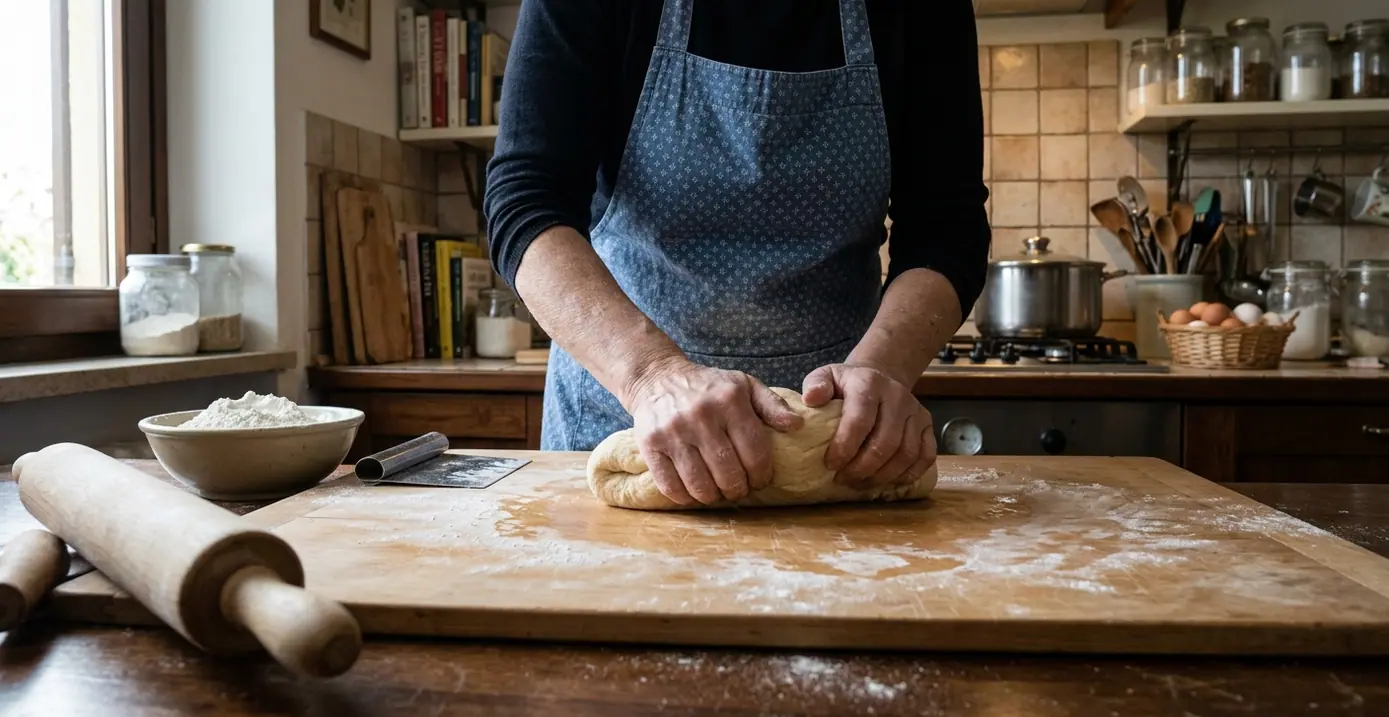
What Can Two Ingredients Tell Your Hands?
Two principal ingredients, flour and eggs, pass through four plainly perceptible states before they become workable pasta dough: wet streaks in dry flour, damp crumb, consolidated mass, then a smooth-surfaced ball.
Nanette’s weeknight batch sets the boundaries for this discussion. She works three eggs into roughly 300 g of flour on a wooden bench, using a fork and bench scraper. It is the familiar household ratio of one egg for just about 100 g of flour, whether the flour is Italian 00 or a plain-flour-and-semola blend of the kind found across Maltese and southern Italian kitchens.
That narrow scope matters. A modest egg dough behaves differently from a restaurant’s large mix, and bread dough brings another set of expectations. Here, the palms can read moisture, resistance and readiness because the entire batch remains within easy reach.
Even apparently simple ingredients introduce variation. A whole egg weighing in the range of 55 to 60 g carries roughly 40 g of water into the flour. A small shift in egg size can therefore move a domestic batch towards tackiness or dryness. Direct contact makes that shift noticeable before it becomes a problem.
Keep the Batch Modest
Use three eggs and roughly 300 g of flour for the first comparison. The lesson lies in feeling each stage clearly, rather than wrestling with more dough than two hands can comfortably turn.
What Does a Pasta Machine Filter Out?
A mixer hook or processor blade supplies steady, uniform force. A hand supplies pressure, receives an answer through the heel of the palm, then changes the next movement.
That pause is the useful difference. After three or four push-fold-turn cycles, the cook can stop, rotate the dough, press a dry seam and decide whether anything has actually changed. A mixer set on low makes no such reassessment until someone switches it off.
Visual cues often tempt an early correction. Around the five-minute mark, a dull or torn surface may look thirsty. Continued compression and a covered rest will often resolve it. Adding liquid at that moment can leave the finished dough sticky. The reverse also occurs: a glossy exterior may conceal a centre with uneven hydration. Cutting the ball in half and checking for chalky streaks offers a cheap, direct test.

The rolling machine still earns its place. Mixing and kneading teach the hands about the dough; rollers thin it evenly and cutters make efficient work of ribbons. A defence of bench kneading need not turn into a purity test about every later step.
How Does Pasta Dough Change Beneath Your Palms?
Follow one batch in order and the cues become easier to interpret.
- Wet streaks appear. The fork loosens the eggs inside the flour well and draws flour inward. At this stage, loose flour around the edge belongs there.
- Damp crumbs gather. A bench scraper lifts the sticky pieces and presses them back into the mixture. Some patches feel tacky while others remain granular.
- The mass consolidates. Firm pressure joins the crumbs. Dry seams become visible only after the dough is compact enough to fold over itself.
- The surface smooths. Repeated folding distributes moisture and develops structure. The ball tightens, then reaches a point where its increasing resistance begins to level off.
The Push, Fold and Turn Rhythm
Push forward with the heel of the palm, fold the far edge back, rotate the dough a quarter turn and repeat. This is a rhythm rather than a rigid rule. The motion usually shortens as the dough becomes tighter.
Resistance often climbs noticeably between roughly the fourth and eighth minute of steady kneading. Its plateau gives a more useful wrapping signal than a fixed timer. Cover the dough and let it rest for approximately 30 to 45 minutes at room temperature. In a Melbourne kitchen below about 16°C, the longer end of that range makes sense.
Rest changes the reading. A stiff but smooth ball often returns softer and more yielding because the existing moisture has continued to travel through the flour. Hydration concerns distribution as much as quantity.
Correct by Teaspoons
Delay any correction for a few turns. If the dough remains genuinely unmanageable, flick on a teaspoon of water or apply a light dusting of flour. A nearly 5 g shift in egg weight, extra semola, a humid summer afternoon or the intended sheet thickness can all alter the same basic recipe.
When Does Touch Become Pasta-Making Judgment?
Useful pasta memory develops through comparison. After several batches, the question changes from “Is this right?” to “Is this tighter or slacker than last Sunday’s?” A photograph cannot answer that question with much confidence; the palms can.
Three States Worth Remembering
- Firm but pliable: the dough resists pressure while still folding without splitting.
- Chalky and cracking: pale, dry seams reopen at the fold and point towards a genuinely dry dough.
- Stiff but smooth: the surface stays coherent, suggesting that covered rest should come before added liquid.
These distinctions carry into rolling. Evenly hydrated dough tends to move through successive roller settings without tearing at the leading edge. Patchy dough usually reveals itself first at the corners. Coherent sheets also make shaping calmer, whether the evening calls for broad ribbons or smaller cut forms.
Diagnosis Before Perfection
The advantage of hand kneading is diagnostic, not a culinary guarantee. Each batch shows how this flour and these eggs behave today. Final texture still depends on resting, sheet thickness, shape, salted water, cooking time and sauce.
When Is Machinery the Better Pasta-Making Choice?
Machinery becomes the sensible tool when the quantity climbs, the schedule contracts or prolonged kneading causes discomfort. At home, mechanical mixing starts to make obvious practical sense above roughly 500 g of flour, or at four eggs and beyond.
A double or triple batch for a family table demands sustained force. A school-night dinner may leave only 40 minutes for active work. Wrists and shoulders can also set their own limits. None of these circumstances makes the meal less meaningful.
A Short Bench Finish
The hybrid method preserves the diagnostic value of touch. Bring the ingredients together mechanically, then knead the dough on the bench for two to three minutes. That brief finish usually gives enough contact to detect a tacky surface, recurring dry seams or a cohesive ball ready to rest.
Machine-assisted dough still benefits from the same 30-to-45-minute covered rest. Faster mixing does not shorten the time the dough needs afterwards. The roller and cutter can then take over without apology.
Try One Pasta Batch Without the Mixer
The next batch can serve as a small kitchen experiment. Clean the bench, mound the flour, form a well and break the eggs into its centre. Draw flour inward with a fork, keeping the bench scraper close for lifting and consolidating the damp crumb.
Knead without allowing a timer to make the final decision. Instead, record three moments:
- The first cohesive mass, usually reached within two to three minutes of scraping and pressing.
- The disappearance of dry seams, when they stop reopening each time the dough folds.
- The softer resistance after rest, felt once the covered dough has sat for 30 to 45 minutes.
Hold back corrective flour or water for at least four or five push-fold-turn cycles, unless the dough sticks to the bench in sheets or crumbles outright. Those extra movements give moisture and pressure time to do their work. They also give the cook better evidence.
The finished pasta matters, of course, but this batch has another purpose: it teaches the sequence beneath the recipe. When the next dough feels stiff and smooth in your palms, will you add water immediately or give it the covered rest it is asking for?