The Mechanics of a Perfect Shatter
The defining characteristic of stracciatella happens in a fraction of a second. A stream of melted chocolate hits gelato that is already at soft-serve stiffness. It sets in the instant of contact. The turning blade then snaps it into irregular ribbons. The size of these shards depends entirely on two factors—the width of the stream and the number of paddle rotations that pass over it.
The chocolate is added in the final 60 to 90 seconds of churning. You watch for the moment the base climbs the paddle in soft ridges that hold their shape for a second or two before slumping. The target texture features delicate shards that crack under the spoon tip and melt on the tongue within a few seconds. Thick slabs resembling chopped chocolate drag the scoop's temperature down and disrupt the mouthfeel.
A useful working quantity for a home batch is 90 to 120 grams of chocolate per litre of base. Beyond that volume, the shards behave like ballast. Achieving the optimal texture requires coordinating chocolate fluidity, gelato consistency, and pouring speed.
Selecting Bars for Fluidity and Melt
The cocoa percentage printed on a label helps anticipate bitterness and intensity. It offers little insight into how fluid the melted chocolate will become. Couverture-style buttons and discs contain a higher cocoa butter fraction. They pour in a finer thread than a supermarket eating bar of the same stated percentage.
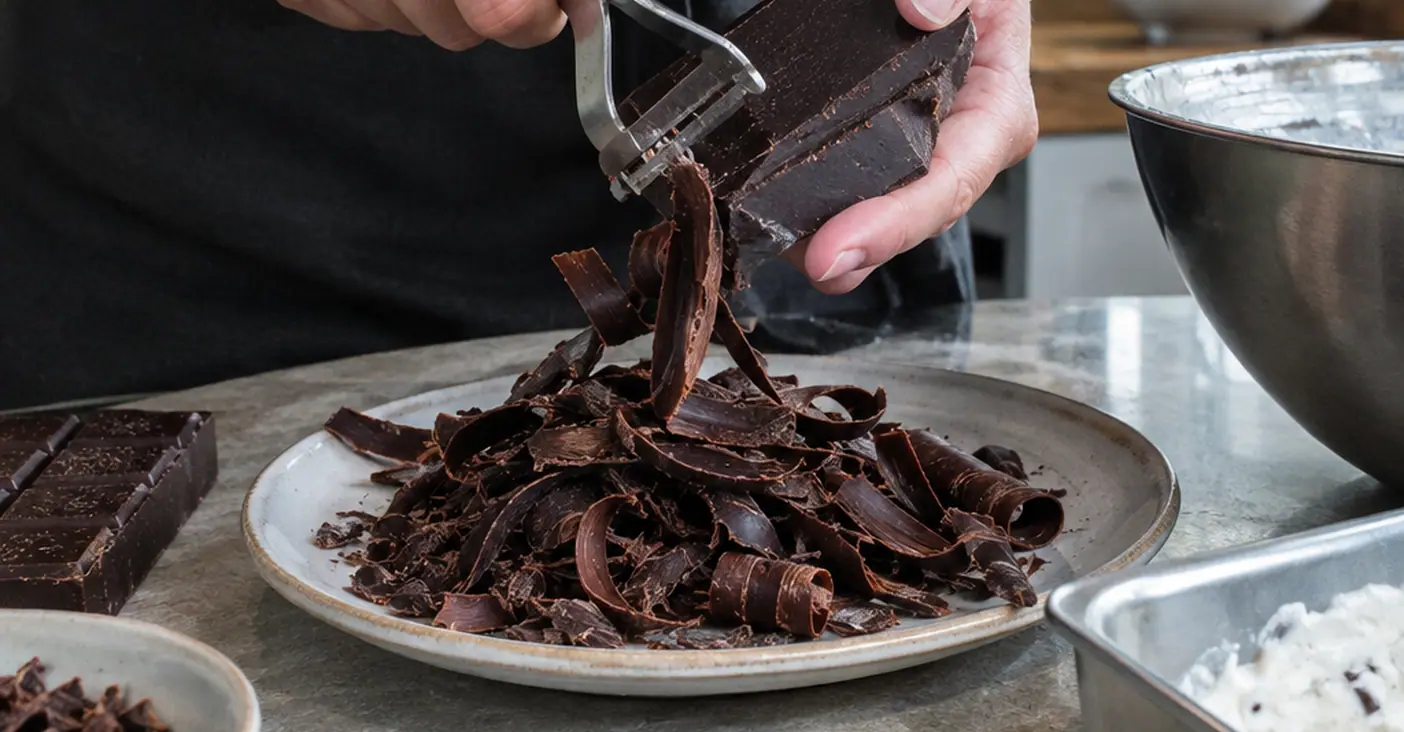
Baking chips are formulated to hold their shape in a hot oven. They often stay pasty even when fully melted, causing a waxy, slow-melting bite in the finished dessert. Chop solid bars to pieces no larger than five millimetres on the edge. The last fragments melt from residual heat, eliminating the need for additional warmth.
Nanette's field notes treat stracciatella as a strict timing job. Her practice involves melting 20 to 30 grams of any new bar and tipping the bowl. If the chocolate runs down the side in a continuous sheet and drips in a thread, it will stream beautifully. If it slides in a mass and breaks into blobs, it will form heavy plates in the churn.
Taste the melted chocolate directly beside a spoonful of the churned base before committing. A very dark bar flattens a delicate fior di latte. A milk chocolate bar vanishes entirely into a rich egg-yolk custard base.
Timing the Thermal Collision
Three observable conditions must align simultaneously. The chocolate falls from the jug lip in an unbroken thread. The gelato is cold enough to set that thread on contact. The base turns freely around the paddle.
Melt the chocolate over water that has stopped steaming. Stir until the last visible pieces disappear. Rest the bowl off the heat for two to four minutes so the chocolate loses its top heat without thickening. Lift the spoon and let the chocolate fall to test its readiness. It should run as a single unbroken thread for 15 to 20 centimetres before breaking, displaying a glossy, fluid surface.
Protect the Melt: A single drop of water or a minute of trapped steam seizes the batch. Once it tightens into a dull paste, extra warmth will fail to restore a pourable thread.
Warm the pouring jug with hot water and dry it thoroughly beforehand. This prevents the first 10 seconds of the pour from setting on cold metal. Machine type dictates the generosity of this window. A compressor machine holds its canister cold throughout, tolerating a deliberate pour. The frozen-bowl boundary is absolute. Roughly four to six minutes after the base reaches soft-serve thickness, the pre-chilled canister has spent its stored cold. Past that line, no pouring technique will set a thread into a shard. The chocolate must be melted, rested, and waiting before the base ever gets there.
Choreographing the Stream
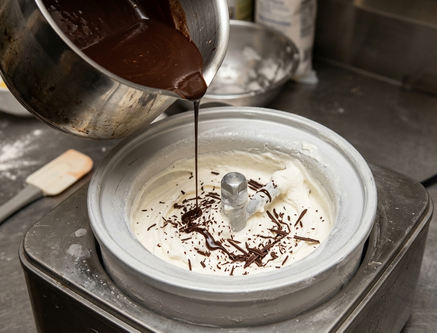
This sequence requires strict adherence. Finish melting the chocolate. Transfer it to a small, dry jug with a narrow lip. Confirm the gelato is thick but mobile. Keep the churn running.
Direct the stream exclusively at the moving surface near the centre of the churn. A stream hitting the canister wall causes the chocolate to freeze into a single heavy sheet. Hold the jug lip 10 to 15 centimetres above the gelato surface. This keeps the thread from wandering onto the rim while keeping hands clear of the paddle.
The thread should match the width of a matchstick. A wider stream lands as a ribbon too thick for the paddle to shatter cleanly. Pour in passes of three to five seconds. Pause for five to 10 seconds between them. The paddle needs time to fracture each ribbon before the next arrives.
Stop pouring while a thin film still coats the jug. Scraping the last thickened mass into the churn produces the one oversized clump in an otherwise fine batch.
Diagnosing the Churn
Every fault traces back to a single variable: stream width, chocolate viscosity, aim point, or residual heat. Derived from Nanette's consecutive home batch trials, the diagnostic logic focuses on correcting the next pour. Most faults remain permanent in a batch that has already taken the chocolate.
While machine variations influence exact timing, the underlying thermal mechanics remain consistent. A hard, waxy bite that persists after 10 seconds in the mouth points at the chocolate's formulation. Repeat the batch with a more fluid couverture-style product before changing anything else.
| What you see or taste | Likely cause | Correction for the next pour |
|---|---|---|
| Powdery brown specks, no crack at all | Stream too fine and held over too many paddle passes | Widen the thread slightly and pour in shorter bursts |
| Thick plates and heavy clumps | Pour was too heavy or chocolate became too viscous | Ensure chocolate runs in a fine thread; warm slightly if thickened |
| Curved sheet frozen to canister wall | Stream aimed at the stationary wall | Aim directly at the moving gelato near the centre |
| Smeared brown streaks, no snap | Base was still slack or chocolate went in too hot | Wait for soft-serve stiffness; rest chocolate 2-4 minutes off heat |
| Hard, waxy bite | Chocolate formulation (likely baking chips) | Switch to a fluid couverture-style product |
The Single-Thread Trial
Every available correction must happen before the bulk goes in. Warming a thickened chocolate, resting an over-hot one, or altering the stream width requires testing. There is no second chance once a litre of base has taken the chocolate.
Pour roughly a teaspoon of chocolate over two to three seconds. Let the paddle make two or three passes. Stop the machine briefly if the model permits. Inspect the shard edge. An optimal shard snaps cleanly against the spoon and softens on the tongue in under five seconds—leaving no waxy coating on the roof of the mouth.
Stopping the machine for this inspection costs 10 to 15 seconds. It should not affect a base already at soft-serve stiffness. Successful homemade stracciatella contains a natural mixture of fine flecks and delicate ribbons. Mechanically uniform chips belong to commercial extrusion processes.
Measure out 100 grams of couverture chocolate, melt it over off-the-heat water, and run the single-thread test in your next batch of fior di latte.