Quick Nav
- Why Mediterranean nut desserts feel so generous
- Criteria for selection: what makes a dessert pantry-worthy?
- The nut dessert pantry
- The almond-led classics
- Pistachio, walnut, and pine nut favourites
- Honeyed pastries and stuffed celebration sweets
- Regional scope, authenticity, and home adaptation
- What to bake first
Why Mediterranean nut desserts feel so generous
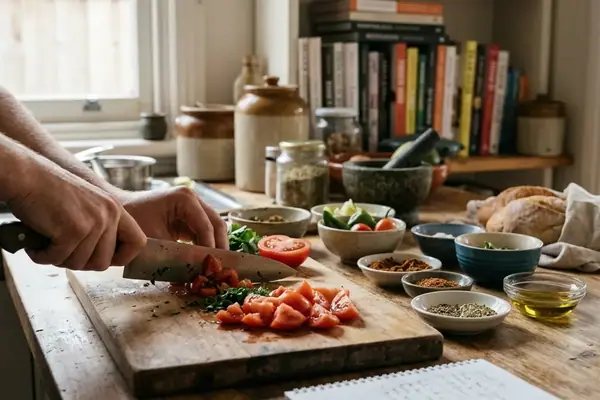
Nanette has a way of reading a pantry that I trust: not as a display shelf, but as a working cupboard. A jar of almonds, a strip of citrus peel drying near the fruit bowl, honey that has crystallised at the rim, a half packet of filo tucked behind the peas. That is where many Mediterranean nut desserts begin.
I do not think of them first as grand showpieces. Some are, certainly. Figolli belong to Easter tables, baklava asks for ceremony, and ma’amoul carries its own festive hush. But the deeper usefulness of these sweets is quieter. Nuts give structure, richness, chew, perfume, and keeping power without asking the cook to do too much on the day.
This guide sits where my own work often sits: between Maltese roots, Italian baking habits, and the wider Mediterranean pantry. I am not trying to crown one tradition as the authority. I am asking a more practical kitchen question: which nut desserts deserve space in a home cook’s regular repertoire?
The answer keeps circling the same ingredients: almonds, pistachios, walnuts, pine nuts, honey, citrus zest, spice, filo, shortcrust, syrup, ricotta, chocolate, and coffee. They travel differently from island to island and family to family, but they share a kind of thrift that never feels mean.
Criteria for selection: what makes a dessert pantry-worthy?
I have kept the list narrow on purpose. A dessert had to earn its place by making nuts central to texture or flavour, not scattering them on top as a polite garnish.
That distinction matters. A sponge with a few chopped pistachios over icing may be lovely, but it does not teach the hand much about nut cookery. A tarta de Santiago does. So does kwareżimal, where ground almonds decide the chew, the slice, and the way honey settles into the surface.
The second filter was pantry recognition. I looked for sweets built around familiar Mediterranean anchors: nuts, honey, citrus, spices, pastry, ricotta, chocolate, or coffee. The third was home technique. These desserts may ask for care, but they should not demand a professional bench or a sugar thermometer for every attempt.
- Flavour: the nut should shape the dessert, not decorate it.
- Heritage value: the sweet should carry a recognisable regional memory or family-table role.
- Achievable technique: the method should suit an attentive home cook.
- Keeping quality: most should hold well for a few days, with syrup-soaked bakes often improving after an overnight rest.
There is one Melbourne bias here, and it is worth naming. Pistachio paste and orange blossom water are easy enough for me to find. A reader elsewhere may need to order ahead or substitute with care.
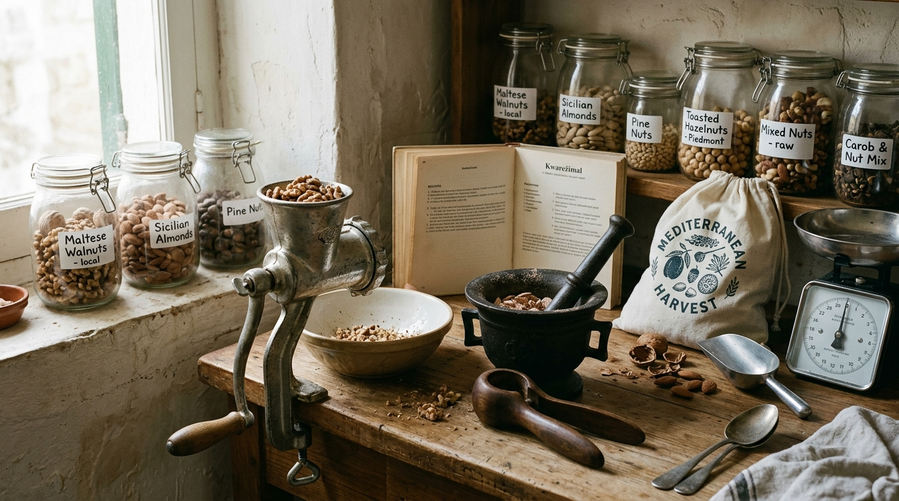
The nut dessert pantry: almonds, pistachios, walnuts, and pine nuts
Here is the quick version I use when developing recipes. Almonds build. Pistachios announce themselves before you taste them. Walnuts deepen. Pine nuts lift and gloss the top note.
Almonds are the most forgiving structural nut. Ground finely, they can hold a cake together; chopped coarsely, they make biscuits feel substantial. Pistachios bring colour and perfume, especially when paired with dairy or blossom water. Walnuts carry an earthy bitterness that loves cinnamon, cloves, coffee, and dark syrup. Pine nuts are smaller and more resinous, sweet but not sugary, and best treated as an accent unless the household budget says otherwise.
Supporting ingredients do much of the quiet work: honey, cinnamon, cloves, sesame, citrus zest, rosewater, orange blossom water, filo, chocolate, and ricotta. I think of them as the grammar around the nut. Change that grammar and the dessert speaks with another accent.
Field Note: Toast nuts gently at 150 to 160C for 8 to 10 minutes, then cool them fully before grinding. Warm almonds, even pulsed in short bursts, can clump into an oily paste and spoil the tender crumb of a tarta de Santiago. Ignore this only when the recipe specifically wants nut butter or a loose pistachio paste.
Storage also changes how I plan. Whole almonds and shelled pistachios are steady in a sealed jar in a cool cupboard for several months. Walnuts and pine nuts, richer in oil, turn stale faster at room temperature. If a walnut smells like old paint, it has already made the decision for you.
The almond-led classics
Almonds lead because they behave. They can be festive or plain, flourless or pastry-wrapped, rustic or polished. In Maltese and Italian-leaning kitchens, they are the nut that lets a cook move from biscuit to cake without changing the pantry too much.
1. Maltese figolli
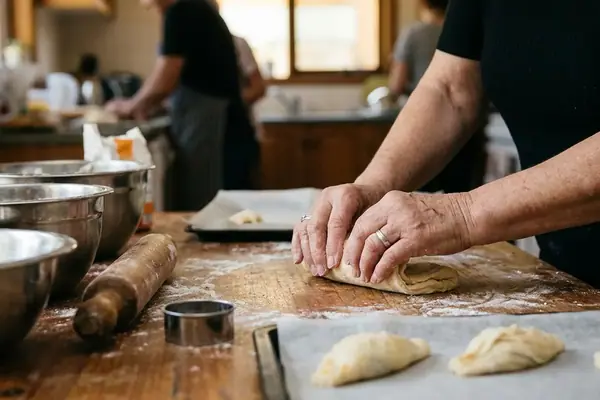
Figolli are almond-filled Easter biscuits, though calling them biscuits makes them sound smaller than they feel in memory. The pastry is citrus-scented and tender, the filling dense with almond, and the shapes often carry family jokes: lambs, hearts, fish, rabbits, sometimes a form no one can identify after baking.
They suit make-ahead baking beautifully. The dough and almond filling can be prepared up to three days ahead, then rolled, cut, filled, and baked on the morning they are needed. That matters when the table is already crowded.
For me, the best figolli do not chase delicacy. They should have a generous middle and a clean edge. The icing can be bright, but the almond has to remain the point.
2. Maltese kwareżimal
Kwareżimal is where I send readers who like a rustic biscuit more than an iced cake. It is chewy, spiced, almond-heavy, and brushed with honey while still receptive enough to shine.
The texture is the pleasure. Not crisp, not soft in the cake sense, but resistant in a way that makes coffee useful. Cinnamon, cloves, citrus zest, and sesame all feel at home here. During practice, I found the biscuit worked best when I stopped trying to neaten it too much; its charm sits in the rough surface and the honeyed pull.
3. Spanish tarta de Santiago
Tarta de Santiago is one of the simplest elegant nut desserts I know. Ground almonds, eggs, sugar, lemon zest, and a restrained hand do most of the work. It has the confidence of a cake that does not need frosting.
The crumb should be tender rather than airy. This is why the almond handling matters so much. Grind cool toasted almonds too long and the mixture turns greasy; fold with impatience and you lose the clean slice. When it is right, lemon lifts the almond without turning the cake sharp.
4. Torta caprese
Torta caprese takes the almond in a darker direction. Chocolate, butter, eggs, and ground almonds make a cake that looks plain until the knife goes in.
I pull it while the centre is still slightly soft, often around the point where a 22cm tin has baked for 25 to 30 minutes. It will sink as it cools. That is not a flaw; that is the structure settling into fudgy confidence.
Compared with tarta de Santiago, caprese is less fragrant and more brooding. Same nut family, entirely different mood.
Pistachio, walnut, and pine nut favourites
This group is less about structure and more about personality. Pistachio, walnut, and pine nut each have a narrower lane than almond, but when they are used well, they are unmistakable.
5. Sicilian pistachio gelato or semifreddo
Pistachio belongs beautifully to frozen sweets because dairy carries its perfume without muffling it. A good pistachio gelato or semifreddo depends on paste more than colour. If it tastes like almond essence wearing green clothes, something has gone sideways.
The appeal here is different from baked nut desserts. There is no crumb to judge, no pastry to blind bake, no syrup line to watch. Instead, the question is balance: pistachio intensity, dairy richness, sweetness, and cold. Semifreddo gives the home cook a softer path because it does not demand the same churning discipline as gelato.
This is the summer choice from the nut pantry.
6. Greek karidopita
Karidopita is walnut cake soaked with spiced syrup, and it only works when the syrup behaves like part of the crumb rather than a flood.
Pour warm syrup over cooled cake, or cold syrup over warm cake, then give it time. Under typical conditions, four to six hours lets the crumb drink slowly. Pour everything at once over a hot cake and the base turns wet while the top stays oddly dry. I have seen that mistake often enough to recognise it from the first slice.
Walnut is the right nut for this job because it brings depth against the syrup. Almond would make a gentler cake. Pistachio would make a perfumed one. Walnut gives karidopita its low, warm register.
7. Italian pine nut tart
Pine nuts ask for restraint. In a pignoli-style tart, they may sit over custard, almond filling, or a soft pastry cream, but they rarely need to become the bulk of the dessert.
That is partly cost and partly flavour. Pine nuts work beautifully as an accent, not far from 60 to 90 grams in a tart, especially when they toast on the surface and release that resinous sweetness. Pine nut quantity varies by household budget and region; some Italian families scatter them thinly, while others lean into a heavier almond-pine nut filling.

The tart is a useful comparison point for home cooks. Not every nut dessert should be dense. Some should shimmer at the edge.
Honeyed pastries and stuffed celebration sweets
Now the table gets louder. These are the sweets that travel in tins, sit beside small cups of coffee, and make people argue gently about whose aunt cuts the neatest diamond.
8. Baklava
Baklava is layers first: filo, melted butter, chopped nuts, more filo, and syrup timed so the pastry sets rather than slumps. Walnut and pistachio versions both have strong regional lives. I do not rank one as more authentic than the other.
For a home tray, brush each filo sheet with melted butter and stack 8 to 12 layers below and above the nut filling. Cut before baking. Syrup after baking. Then wait at least six hours, or better, make it the day before serving.
Important: Baklava punishes rushing after it leaves the oven. If the syrup and pastry do not settle together, the top flakes apart while the bottom goes heavy.
9. Ma’amoul with walnuts or pistachios
Ma’amoul gives a different kind of pleasure: small, moulded, short, and filled. The filling may be walnuts, pistachios, dates, or a mixture. The shell should crumble softly rather than snap.
Spice matters here, but it should not trample the nut. A little blossom water or rosewater can make the filling feel lifted; too much and the biscuit tastes perfumed instead of baked. I like ma’amoul because each piece feels complete. No slice negotiation. No grand plating.
10. North African almond ghriba
Almond ghriba are cracked cookies, often citrus-scented or touched with blossom water, and they are especially friendly to home bakers who want a flour-minimal sweet. They look dramatic with very little decoration.
The cracked surface tells you about the interior: tender, chewy, and almond-led. This is a good recipe to repeat because tiny changes in grinding, sugar, and baking time show up clearly. It teaches without scolding.
A note on regional scope, authenticity, and home adaptation
This is a home-cooking guide, not a definitive survey of every Mediterranean dessert tradition. That boundary is important. Regional families and bakeries may use different names, fillings, shapes, moulds, feast days, and rules about what belongs when.
My Maltese-rooted, Melbourne-based lens informs the selection. It also limits it. Community observation suggests that the same dessert name can carry several family methods, especially when migration, ingredient access, and holiday calendars reshape the kitchen.
So I adapt, but not carelessly. Substitutions should respect the role of the nut, not just its flavour. Use almonds when the dessert needs structure. Use walnuts when it needs depth. Use pistachios when aroma matters. Use pine nuts when a small accent can change the whole finish.
The habit I keep returning to is comparison. Put two almond cakes side by side, or a syruped walnut cake beside baklava, and the pantry starts to explain itself.
What to bake first from the Mediterranean nut pantry
If you want Maltese heritage, start with figolli or kwareżimal. Figolli are festive and generous; kwareżimal is rougher, spiced, and deeply satisfying with coffee.
If you want simplicity, bake tarta de Santiago. If you want chocolate, bake torta caprese. If you want ceremony, make baklava the day before people arrive. If it is hot and you have good pistachio paste, make semifreddo.
Nut desserts reward repetition. Toasting, grinding, and syrup timing are the three variables I would repeat two or three times before judging a recipe. They change the crumb, the scent, and the way sweetness lands.
Start with one nut already in the pantry. Almonds if you want structure. Walnuts if the evening feels cool. Pistachios if you want perfume. Pine nuts if you have just enough for the top of a tart.
That is how a Mediterranean nut pantry grows: not by collecting everything at once, but by baking one sweet until your hands know what the recipe meant.