Start with the Filling, Not the Pastry
The pastry is rarely the first decision. The filling is.
That is the rule I keep coming back to when I compare Maltese, Sicilian, Italian, and broader Mediterranean home bakes in the Gourmet Worrier archive. A tart filled with warm custard asks a different question from a jam slice that must survive the school-lunch knife. A spinach pie, heavy with greens and cheese, needs a shell that protects and crisps. A chilled chocolate square needs a base that cuts without collapsing.
So I choose pastry according to four things: filling moisture, serving temperature, cutting style, and the amount of structure the bake needs. Not prestige. Not what sounds prettiest in French.
This is a home-cook guide, not a pastry-school manual. I am interested in the point where a shell goes soggy, a slice smears under the knife, or filo turns from crisp to leathery because the filling was wetter than the sheets could bear. That is where the useful decisions live.
The Gourmet Worrier angle is naturally Mediterranean and Italian-leaning: custards, filo pies, biscuits, slices, cream desserts, and pastry bakes drawn from Ms.Gourmet's long-running archive. Some are neat. Some are gloriously homely. All of them teach you something about the relationship between filling and base.
What This Guide Can and Cannot Decide for You
A framework, not a formal test
This guide helps you choose between pastry families for tarts, biscuits, slices, and Mediterranean-style bakes. It does not test every flour, every butter, or every formula against every filling.
The archive references here are cooking context, not statistical proof. The Crema Catalana post from 5 November 2009, the spanakopita adaptation from 3 February 2010, and the coiled filo pie post from 3 August 2010 show how dishes behave in a real kitchen. They do not turn one household method into a universal law.
Important: Butter brand, flour protein, room temperature, kitchen humidity, and oven behaviour can shift results enough that these recommendations work as a decision framework rather than a guarantee. Adjust for your recipe and your kitchen.
That qualification matters. A shortcrust that behaves beautifully in a cool Melbourne kitchen can soften fast beside a summer oven. Filo that feels manageable on one day can crack on another. During practice, the best cooks I watch make small adjustments early rather than heroic rescues late.
The Main Pastry Families and What They Do Best
Match the base to the filling's behaviour
I do not rank these bases by elegance. I match them to the work they must do.
Plain shortcrust gives savoury fillings a firm, clean frame. Sweet shortcrust adds sugar and tenderness for fruit and custard. Puff pastry brings rise and buttery lift, but it dislikes very wet fillings underneath. Filo offers crisp, separate layers and a thin shell around fillings that have been drained or managed carefully. Biscuit crumb bases are practical for chilled slices. Pressed dough bases give richer bars a sturdier bite. Sponge or savoiardi-style layers are different again because they absorb rather than support.
| Pastry type | Best use | Filling moisture tolerance | Serving style | Common failure |
|---|---|---|---|---|
| Shortcrust, plain | Savoury tarts, quiches, meat and vegetable fillings | Moderate; better after blind baking | Warm or room temperature | Gummy base when filled before the shell is dry |
| Sweet shortcrust | Fruit tarts, custard tarts, jam tarts | Moderate; needs careful baking | Cool or room temperature | Cracking, shrinking, or softening under wet fruit |
| Puff pastry | Turnovers, lids, rustic galettes, dry-ish fillings | Low underneath wet fillings | Best soon after baking | Dense, greasy layers under custard or watery fruit |
| Filo pastry | Layered pies, spanakopita-style bakes, nut pastries | Moderate when filling is not watery | Warm or room temperature | Soft layers from overfilling or under-baking |
| Biscuit crumb base | No-bake slices, chilled cheesecakes, chocolate bars | Good when chilled and bound well | Cold | Crumbles if chilled too briefly |
| Savoiardi-style layers | Cream desserts, coffee or Marsala-soaked layers | High by design | Cold and spooned | Expecting crunch where absorption is intended |
Texture follows function: crumbly, flaky, shattering, chewy, crisp, tender, or absorbent. A nut filling wants containment. Jam wants control. Chocolate wants a clean cut. Cream wants either a crisp contrast or a soft layer that welcomes it.
For Tarts: Choose Strength Before Sweetness
The shell has a job before it has a flavour
A tart shell must hold its shape in the tin, take filling without buckling, and cut cleanly once cooled. Sweetness comes after that.
For savoury tarts, plain shortcrust is usually the sensible choice. It has enough firmness for cheese, spinach, onion, pumpkin, mushrooms, or spiced meat and vegetable fillings. For fruit and custard tarts, sweet shortcrust brings a more tender bite, though it still needs enough baking to resist moisture. Richer pâte-style pastry suits tarts where tenderness matters more than portability: a dessert you plate carefully at home, not one you wrap and carry across town.
A custard tart shell that looks set on top but was poured into an unbaked base turns gummy underneath. The fix is baking the shell until the floor is dry, not baking the filling longer.
Field Note: For blind baking, chill the lined tin for 20 to 30 minutes, weight the base, and bake until the surface looks dry and matte before adding wet fillings. If you are pouring custard, sieve it once through a fine mesh to remove lumps and give the set surface a cleaner finish.
Crema Catalana makes the reverse point. It is a set custard served in shallow cazuelas with no pastry at all, so the instinct to find it a crust is the wrong starting point. Some custards need a spoon, not a shell.
For Biscuits and Slices: Think About the Cut
Squares, slabs, snaps, and chilled edges
With biscuits and slices, I stop asking, “Which pastry?” and start asking, “How will this be cut?”
A bake snapped by hand can be more fragile than one cut into squares. A layered slice needs a base that tolerates pressure from a knife. A chilled bar with caramel, chocolate, jam, cream cheese, or nuts needs sturdiness before delicacy. That is where biscuit-style dough often beats pastry.
Pressed dough bases are especially useful when the topping is rich. They give the knife something to move through without dragging the filling into crumbs. Crumb bases, by contrast, trade elegance for ease: crushed biscuits, butter, a firm press into the tin, then enough chilling to behave.
A crumb base for a chilled slice needs upward of 1 hour, and sometimes 2, of firm chilling before it slices cleanly. A brief chill leaves it crumbling under the knife.
If a slice must travel or hold for several hours, skip delicate bases that soften under a wet topping. That is not pessimism. It is hospitality. Nobody wants to hand over a beautiful slice that has become paste by the time it reaches the table.
When to Use Filo, Puff, or a Coiled Pastry Shape
Two layered pastries, different instincts
Puff and filo both promise drama, but they do it differently. Puff pastry provides rise and buttery lift. Filo provides crisp sheets and a thin, crackling shell around filling.
Choose puff when the filling is controlled and the pastry has room to expand: turnovers, lids, small parcels, or rustic bakes where lift is the pleasure. Be cautious when the filling sits wet and heavy on top of the raw pastry. Puff can steam, slump, and lose the separation that makes it worth using.
Filo behaves more like architecture. Spanakopita is the useful template: multiple sheets, fat brushed between layers, and a filling that is moist but not watery. Cheese, greens, herbs, and egg can work beautifully if excess liquid is squeezed out or cooked off first. Baharat or a similar spice blend can enter the filling for aroma without changing the pastry structure.
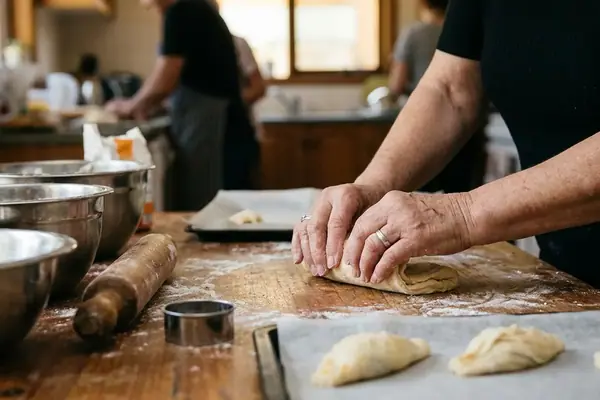
The coiled filo pie technique in the Gourmet Worrier archive is distinctively Mediterranean: filled filo rolls are spiralled into a baking dish, so the shape itself creates contrast between crisp ridges and softer inner folds. It is generous food. It also teaches restraint. Too much filling bursts the roll; too little makes the pie all shell.
A Simple Decision Checklist Before You Bake
Ask these in order
- Identify the filling moisture. Custard, wet fruit, spinach, syrup, cream, and cheese each behave differently. Drain, cook down, chill, or thicken before blaming the pastry.
- Decide whether the dish is served hot, cool, or cold. Puff is most persuasive soon after baking. Crumb bases rely on cold firmness. Tarts often cut best after cooling.
- Choose the pan. A fluted tart tin asks for a structured shell. A slice tin suits pressed dough or crumb bases. A shallow dish may not need pastry at all.
- Decide whether it must travel. Portable bakes need firmer bases and cleaner edges. Delicate tart shells are better served close to the oven that made them.
- Choose the desired texture. Crisp, flaky, tender, chewy, crumbly, or absorbent: one of these must lead.
A lemon tart needs a baked shell because the filling is wet and the cut must be clean. A chocolate slice needs a firm base because richness magnifies mess. A syrup-soaked Middle Eastern cake such as basbousa is not really a pastry problem; it is a crumb-and-syrup balance problem.
Julie Le Clerc's Taking Tea in the Medina is noted in the archive as the source context for a basbousa-style dessert, which is a useful reminder. Some sweets sit outside classic pastry categories, and forcing them into one only muddies the decision.
Common Mistakes and the Pastry Choice to Make Instead
Useful swaps, not rigid rules
The right pastry is usually the one that removes the most obvious weakness in the dish.
- Use shortcrust instead of puff for custard tarts, especially when the filling needs time to set gently.
- Use a biscuit base instead of delicate pastry for rich slices with caramel, chocolate, jam, or cream cheese toppings.
- Use filo instead of puff for crisp layered pies where thin sheets and a contained filling matter more than lift.
- Use savoiardi only when absorption is wanted. Savoiardi behave the opposite way to a crisp base: in a Marsala or coffee layer they are supposed to soften and absorb, and a cook expecting crunch will read the dessert as a failure.
The common errors are plain but stubborn: underbaking tart shells, overfilling filo, using puff under very wet fillings, and chilling crumb bases too briefly. Each one starts as a pastry choice and ends as a serving problem.
Bottom Line: The best pastry is not the fanciest one. It is the one that carries the filling, cuts neatly, and suits the way the dish will be shared.
That is a very Maltese way to think about baking, at least in my kitchen: practical first, generous always, with room for memory. A tart, a slice, or a coiled filo pie earns its place at the table by holding together long enough for people to enjoy it.